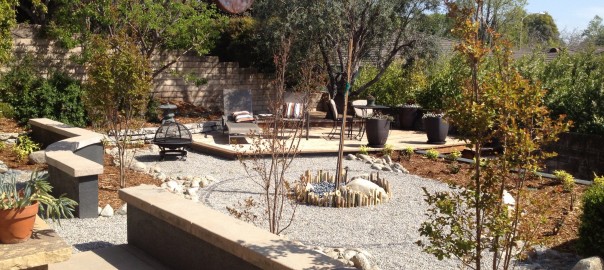
During the pandemic, we had to learn how to work without being onsite. With the help of Google Earth and county records, we were able to continue designing gardens from Los Angeles. What began as helping friends across the country create safe, socially distanced outdoor spaces soon spread by word of mouth—and turned into projects in other states. Since then, we’ve designed gardens in Alabama, Mississippi, Tennessee, Louisiana, Wisconsin, California, and Washington.
Before the pandemic, we accepted projects outside of California, but always traveled in person. We were surprised at how well online design worked. In fact, one of the biggest benefits has been spending more time talking with clients about their needs and dreams. That extra time and attention has led to stronger projects—and meaningful connections.
Here are a few of the project we have created using this new fangled technology.
A plan for plant relocation.A new color scheme diagram.A preliminary plan in MemphisA courtyard for Condos in TennesseeA preliminary plan for a project in MississippiA diagram illustrating the photos we need.
Over the years we have designed and installed dozens of gardens. As I look back on them, a few things pop out to me that helps identify what we do best. The first thing is organization. It is perhaps our greatest skill and I think the most important part of designing a garden. Designing the orientation of a garden is essential to how well it flows. It’s also crucial to know how the sun moves through your property at different times of the year. For instance, if the garden is geared for summer activities, we’ll want to have plenty of sun, but also an escape from the sun. Using a strategically placed tree will provide some shade, but also if a deciduous tree is used, we have winter sun and warmth. This will extend the outdoor season by a month or two in warm climates, and by a few weeks in cooler areas. This is planning—solving multiple issues with one solution. The garden will be vastly different in the Summer and Winter. Not only are temperatures different but the sunshine is polar-opposite. Organizing plants is another key issue. Some plants like winter sun and summer shade, these are typically the plants that boom in the Spring. Understanding the space and what goes in it and where is key to garden organization.
So, why is organizing a space important? It is the one thing no one can identify, but can feel. It’s that notable feeling of being somewhere special…. We’ve all been in a place that just feels right, that is a sign that someone has thought about how you as a guest would feel while in that very space. A well organized space determines if a space is usable or just something to look at. A space needs to feel right to keep people coming back. That feeling starts with an organized space.
There are plenty of people who create landscapes for people, few of us create gardens. A garden is a place that has serenity because it is designed especially for those who live there and their guests. The gardens we create are comforting and comfortable spaces built on organization. We’ve discussed organizing the space as a whole, looking further we organize individual spaces within the property at large. We think of the garden as an extension to the indoor living spaces. In most cases we divide the future garden into outdoor rooms based on what our clients enjoy doing while outdoors and the relationship with the indoor rooms. For example, an outdoor dinning room should be associated with the Kitchen. For the outdoor dinning room to be successful, it must have easy access to the place the food is prepared. With the proper location, we can begin to create a room that feels like an outdoor home and is functionally easy to use. After the area is selected we start by finding the table that will be the center piece. We could use an an existing table, or buy another one. We also think about how you and your guests will move about the space considering what defines the room. Having a table that fits like a glove is key. In addition we use plants and/or simple structures to complete the scene. Lighting is also important as it brings the space alive at night.
If a client calls us, they are typically looking for a unique garden. We use thoughtfully selected plants; plus decorative arts to define these spaces. There are so many options for a garden, it’s all about listening to our clients then organizing their wishes so it works best. Creating a collection of furnishings and decorative arts says more about the owner than a suite of furniture especially as we start with what the owner has already. Suites of furniture tend to work better in ultra-modern spaces. We like to incorporate something vintage in modern spaces. It gives the space resonance—it gives life to the space. Starting with what is available and incorporating that into a space will always have a resonance for the owner and their guests. Selecting hand made pieces tend to have a quality that manufactured pieces don’t have. We find many of our pieces at Flea Markets. When pieces are made by a craftsperson, they anchor their own spirit in the piece. This is the resonance I am talking about. When there is a collection of pieces we rely on that resonance to create a unified spirit-filled living space with character. We think there is magic created when the garden comes together using pieces that have been selected by their spirit instead of a manufactured look.
Plants are also an integral part of a garden. There is no such thing as a “no maintenance” garden, though with proper selection plants are much less maintenance. For instance, a common mistake is buying a small plant that grows too big for the space. If there is a 3’ wide space, there is no reason to plant that matures at 4’ wide(unless a manicured hedge is required). This creates a space that requires maintenance. There is also the amount of sun at any given time of the year that must be considered. This is perhaps the most important part of a planting design because a plant that requires sun will not grow in the shade… and vice versa. Knowing plants and where they belong comes naturally to us. We have been hired for larger projects just for that reason alone. One other important factor are the soils. We typically look first at any existing large trees in a space to determine what the soil is like. There are two extremes in soils—acid or alkaline and there is middle ground, too. For instance, if you have Pine trees living in your garden your soil is Acid. Large trees tend to terraform the soil around them. So we’d want to plant acid loving plants because plants that prefer a sweeter (alkaline) soil will not grow well. These are the keys to minimal garden maintenance. This is a complicated process, but these factors determine if you have a lush gorgeous garden or one that is a constant struggle to keep beautiful.
All these components are what make our gardens special places. We do our best to imagine how a space will work and bring these components into the design. Every one of our garden designs is different and I am so proud of that. If you decide to call on us for help, then I know you want something functional, stylish, and exceptional.
The whole great State of California has a mandate to reduce water use by 25%. Although it is going to be diffuclt, we can easily achieve this–stop watering our lawns. This will be a massive savings of water since about 9 out of 10 homeowners have lawn.
The design aspect of having a lawn, may seem simple, but that is because it is over used. The real issue is complex. First of all, lawns are a necesary evil, especially if you have children, pets or enjoy outdoor activities. There is nothing like grass to take foot traffic. So, not all lawns are objectable. The issue is how we have all used grass as a ground cover, millions and millions of Californians. I say, if the only person who walks on your lawn is the gardener, then let that lawn go! A lawn should be no more than 30% of your total gardening space. As we are in a dought I would reduce that number by half. We must sacrifice, there is no choice. I also object to municipal medians and parkways that use grass as a ground cover. Again, if the only person who walks on it is the gardener—-let it go!
At Indah Bulan, we tend to always remove lawns except where useful . Here are some alternatives to having a lawn or lawn substitutes.
Red Fescue (Festuca rubrum) This is a California native grass that grows well with little water.
Mulch…. until you can figure out what to do, simply much the dead lawn.
For areas to be used for entertaining, use pavers set in gravel. This will allow the water to percolate back into the ground, create a pattern and most importantly define an area with style.
Succulents, these can be planted year round and enjoy being dry. Most tend to be more colorful with dry heat.
Plant a Grove of Trees… fill your old lawn area with trees, turn it into a woodland.
Create a path and planting areas. This creates a garden that has visual interest and practicality if the paths are well thought out.
Evergreen Ground Covers. There are hundreds of choices. If you want a look to replicate grass, choose a plant with small leaves. A really good choice is Achillea milliafolium. It is a low growning yarrow, that can take some foot traffic, being mowed, and has a flower.
Create a riparian area with native rocks, trees, shrubs and design.
Create a planting design that uses mass plantings of a single variety of low shrub(s).
Do nothing until you have a plan. Mow the grass down as low to the ground as possble, stop watering and take time to dream. Use the drought to solve a problem thoughtfully.
There really are so many wonderful options. When we design a garden for clients, we choose what is best for them, the architecture of their home and how they want to use it. This is a great opportunity to create something that is special, practical, sustainable and gorgeous.
Welcome to our Indah Bulan blog about gardening. Our goal is to provide helpful information to our clients and those who share our love of gardening. Our first series of blogs is about Water Conservation. Thank you for finding us! …..Stephen Swafford
Stephen is a partner and landscape architect for Indah Bulan, Los Angeles